
What's on · Thu 26 Nov 2026
The Cameron Highlands: tea, trails and the cool escape
Four hours and fifteen degrees separate Kuala Lumpur from the Cameron Highlands, Malaysia's original hill station, where the temperature sits around 18 degrees, the hills are combed into tea gardens and the nights ask for a jacket. BOH's tea terraces, the mossy forest, strawberry farms and market towns, and the honest choice between the day tour and staying up in the cool. A guide to the highlands that takes the weather seriously.
There is a moment on the road up to the Cameron Highlands when the air conditioning goes off and the windows come down, and it is not politeness. The temperature outside has dropped through the twenties and kept falling, the smell has changed from city to wet green, and the road has started its long switchback climb into the clouds. The highlands, a plateau district in Pahang about 712 square kilometres in size, with settlements strung between 800 and 1,603 metres above sea level, are Malaysia's standing answer to its own climate: a place where the mean annual temperature is about 18 degrees, the day seldom climbs past 25, and the night, at the higher reaches, can fall to 9 or 10. Malaysians have been escaping up here for a century. This guide covers what they come for, the tea, the farms, the forest and the cool itself, and the one decision that shapes the trip: the long day tour, or a night in the hills. Current seasonal listings sit on our events calendar.
A surveyor, a hill station, a tea empire
The district takes its name from William Cameron, the government surveyor who mapped the plateau in 1885 and reported a gentle, cool country ripe for a hill station. The British built one, slowly, once the road arrived in the twentieth century: bungalows, a golf course, gardens growing English vegetables and roses in volcanic patience against the tropics. Tea followed the climate. BOH Plantations, founded in 1929, became and remains Malaysia's largest tea producer, and its estates, the original garden at Habu near Ringlet, where the first factory rose in the 1930s, and the Sungei Palas estate above Brinchang, are still the highlands' defining landscape: whole hillsides combed into dark green terraces, hedges of tea following every contour like corduroy.
The towns are strung along the one road: Ringlet in the south, then Tanah Rata, the administrative centre and the travellers' base, then Brinchang, the highest and coldest of the three, with the night markets and the farms around it. Everything in the highlands is near everything else, and everything takes longer than the map suggests, because the road is a single winding thread and the whole of Malaysia drives up it on weekends.
The tea, taken properly
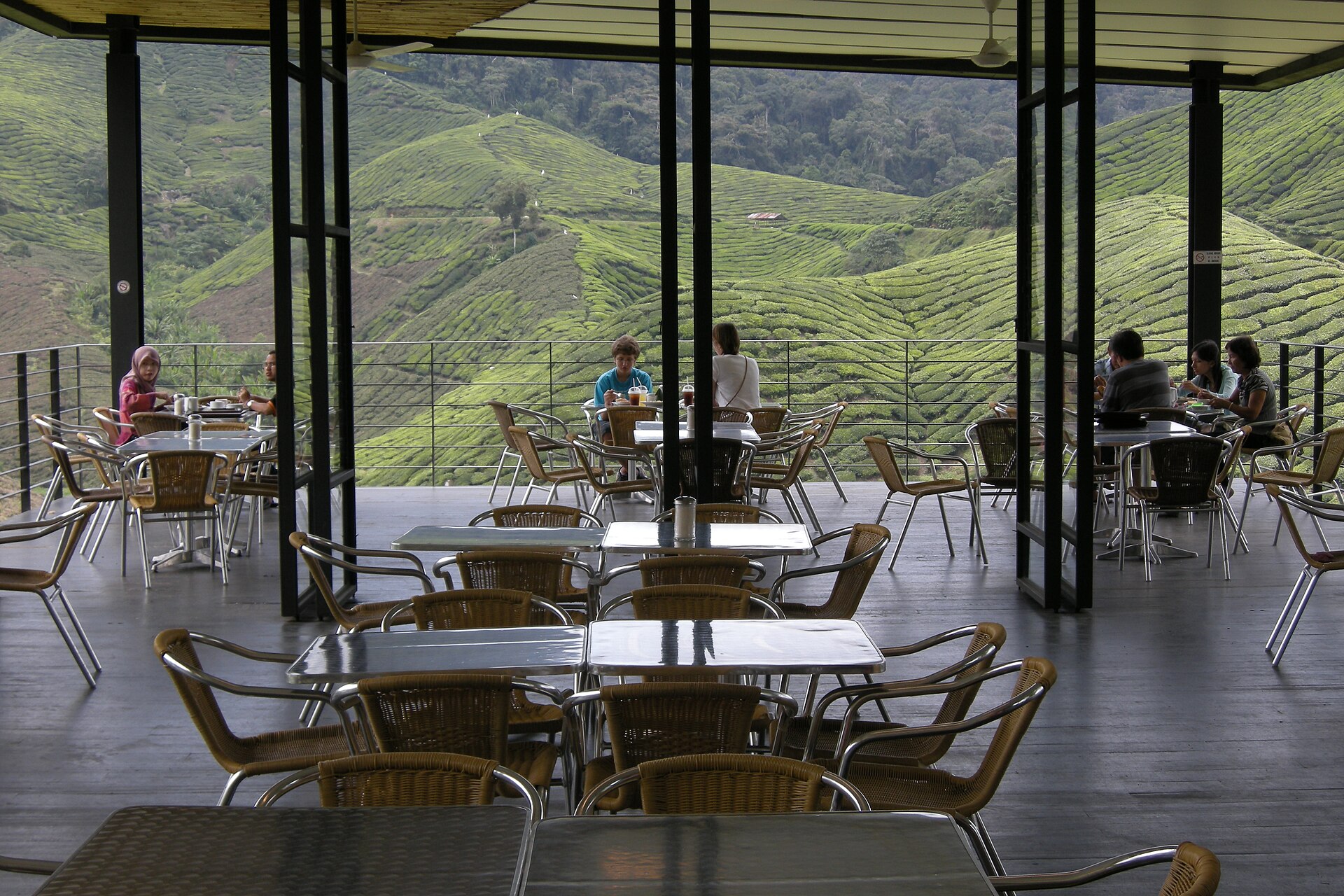
The Sungei Palas Tea Centre, BOH's visitor centre above Brinchang, is the highlands' essential stop: a factory tour through the withering, rolling and grading of the leaf, an exhibition on the estate's history, and a tea house whose terrace hangs over the terraces themselves, which is the view in the photograph above. The centre is open Tuesday to Sunday, 8:30am to 4:30pm, and closed on Mondays except on school and public holidays, a detail that has ambushed many a Monday day trip; general entry is free, with paid tasting and factory packages for those who want the full ceremony. The Habu garden near Ringlet, BOH's oldest, offers the quieter version of the same story. Cameron Valley's estate, on the road the day tours take, adds a third terrace view with its own tea house. Wherever you drink it, drink the local leaf black and strong at least once; highland tea grown at altitude is the district's whole point in a cup.
Farms, markets and the mossy forest
The highlands grow what the lowlands cannot, and the farm circuit is the second half of the visit. Strawberry farms around Brinchang and Kea Farm let you pick your own berries, a novelty that only works because strawberries will not fruit in Kuala Lumpur's heat. The Agro Market and the Kea Farm market stalls sell the plateau's produce: sweet corn eaten hot from the steamer, sweet potatoes, honey, flowers, cactus and more strawberries in every form. Then, above it all, the forest. Gunung Brinchang, at about 2,031 metres the district's highest road accessible peak, carries the Mossy Forest on its slopes, a cloud forest of twisted, moss drowned trees and pitcher plants where the boardwalk runs through permanent mist. It is the highlands' one genuinely wild experience, and the one most sensitive to weather; in heavy rain the mountain closes itself. On the road up from the lowlands, the day tours stop at Lata Iskandar waterfall, a tall cascade beside the road that serves as the climb's halfway ceremony.
The honest choice: day tour or stay
The day tour from Kuala Lumpur is a feat of endurance dressed as an excursion: about four hours each way on the road, the highlands compressed into the middle, a tea estate, a strawberry farm, the market and the waterfall, lunch included, home by night. It exists because it works, barely, for travellers with one spare day, and the operators who run it have the stops timed to the minute. But the arithmetic should be faced honestly: eight hours of winding road for five hours of highlands, and the highlands' best quality, the cool of the evening and the early morning mist, is exactly what the day tour never touches.
Book the Cameron Highlands day tour with lunchvia Viator · affiliate link
Stay one night and the district changes. Tanah Rata and Brinchang empty of day trippers by five, the temperature falls with the light, dinner is steamboat, the highlands' signature meal, a bubbling shared hotpot built for cold weather, and the morning opens with markets, empty trails and tea terraces under cloud before the first tour bus arrives. Two nights allows the mossy forest, a proper trail, there are numbered walking trails between the towns, some requiring guides, and a second estate at leisure. Whenever you go, pack for the numbers at the top of this piece: layers, a jacket for the evening, and shoes that forgive wet paths. The highlands are not cold by any temperate standard. By Malaysian standards they are another country, and that is precisely why the road up is full.
Stay in Kuala Lumpurvia Trip.com · affiliate link
The road up, and the weekend problem
There are two ways up, and the choice shapes the day. The older road climbs from Tapah, on the Kuala Lumpur side, in a long series of switchbacks past Lata Iskandar waterfall; it is the scenic route, the one the day tours take, and the one most prone to slow traffic and queuing at the bends. The newer road from Simpang Pulai, on the Ipoh side, is wider and gentler, and serves travellers approaching from the north. Both deliver you to the same plateau, but neither forgives a late start on a public holiday weekend, when the climb can stretch well past its usual length and the towns at the top fill by noon. The local rules follow from that arithmetic. Travel on a weekday if the trip allows it. If it does not, sleep up there rather than day tripping, so the congested hours are spent at a tea terrace instead of in the queue for one, and drive down on the far side of the weekend peak rather than inside it.
The highlands also ask a small honesty of their visitors. This is a working agricultural district under real pressure from its own popularity: the farms, the markets and the terraces are businesses, the forest is fragile, and the cool that everyone comes for is a climate, not an air conditioning system that can be turned up. Take the trails that are open, use guides where the trailheads ask for them, and leave the mossy forest's moss on its trees. The district has survived a century of visitors by being loved at a sustainable pace. It rewards the ones who keep that pace.
One practical word on altitude and appetite. At 1,500 metres the air is cool rather than cold, but the sun at this height burns faster than lowland skin expects, and the walking, trails, farm rows, the climb to the mossy forest boardwalk, is all gently uphill. Eat the highlands way: a cooked breakfast, tea often, steamboat when the evening temperature falls. The district feeds its visitors the way it clothes them, in layers.
More reading on the articles page, or go straight to the events calendar.
Noteworthy events direct to your inbox.
Get what’s noteworthy for the weekend and beyond every Wednesday in your inbox.